
Table of Contents
Introduction
We live in a magic era. It has never been easier to make money. It has never been cheaper to start a business. Markets have never been more accessible. The cost of doing business has never been lower.
Why is that?
The name of the magic is “Digital marketing”.
Imagine, you live in the early 1800s. Adam Smith has already written his “Wealth of Nations” and the international business has just appeared. There are huge, state-owned companies that trade with the New World. There are also some private companies, much smaller than the state-owned ones that try to make money. You are one of these.
You have just bought some spices from the Indias and your ships are sailing towards Europe. You know NOTHING about them. Just of couple of words would be enough – “Ships have sailed. Everything’s fine”. Nope. There are still 30 more years to the invention of the telegraph.
The necessary capital is absolutely enormous, so is the risk of the undertaking. You need to hire or buy a flotilla of ships – a small fortune per se. You also need to pay armed guards to protect the goods. More expenses.
Banks already exist, but they are in a very young stage of their development and most of them don’t have yet branches in the New territories. You have to bring all of your gold with you to pay the goods. Risky.
Oceans are full of pirates looking for people like you. Storms are common through the oceans. More and more risks.
Insurance companies exist, but they refuse to insure undertaking like yours, because it is extremely risky.
So, you spent a fortune to start a business, just sent all of your money with a few small ships and the only thing that you could do is waiting. For your ships to come back, or for the news that they have been robbed/sunk/destroyed. You have to wait like half a year to hear from your guys. If ever.
How does this sound? Horrible, right…

But these were the ways of doing business some 200 years ago.
How you can start a business now?
You pay like $50 for a hosting, you install a copy of WordPress (for free), you install a copy of WooCommerce (for free) and you can start selling. Of course, there are some other things to do, in order to succeed, but basically, this is all you need to start making money.
Money can flow the same day you open your shop. And even if the risk is huge, you are not losing anything. Because the investment is practically zero.
In this article, I am going to tell you what digital marketing is. How it has changed the world of business, what its main components are, how it works and how it can change your life forever, giving you the financial freedom your parents have never had.
So, let’s go.
Two ways of doing business
There are only two ways of running a business. A smart one and a dumb one.
In a classic business, running a company without a clear business strategy results in an imminent failure. Why is that?
It’s because running a business without a strategy is a dumb way of doing business. And according to some statistics, only 2 percent of the companies worldwide have a strategy.
What is strategy? Business strategy is the thing that gives meaning of the existing of a company. It gives a direct answer to the question “Why my company exists”. Answering this question gives direction to your company. And it makes your business succeed, because everybody in the company knows where the company is heading and why it exists.
Here, I am going to show you how to do business the smart way. With all of the business automation nowadays, it is extremely easy to slip out of your direction. I am going to show you how not to do that.
So, what is digital marketing?
You can hear plenty of definitions of this term. I believe, the most popular one is:
“Applying the principles of classic marketing through digital channels with digital tools for the purpose of running a digital business”.
It sounds pretty self-explanatory, right? Using new technologies to run classic marketing stuff.
Well, this is more or less the right answer. Still, the world is plenty of people that have wrong understanding of digital marketing. Very wrong, in fact.
Why is that? Simple answer is that there are very few people understanding what marketing is.
That is the reason that the first pillar of digital marketing I am putting here is actually the classic marketing. It is very difficult to understand digital marketing without understanding the classic one.
Not knowing digital marketing leads to dumb business. I am going to show you how to apply the best practices of classic marketing in the digital one.
You can find some more detailed explanation of how the Internet functions and how you can setup your own website on this post –> The magic of Internet – its 3 main pillars and how it works.
1. Classic marketing
What is marketing?
If you ask a person working in a marketing agency what marketing is, the most probable answer would be something like:
“To market the products of the company through different ways of advertising in order to improve sales and customer satisfaction.”
Well, this sounds great, but it is absolutely wrong.
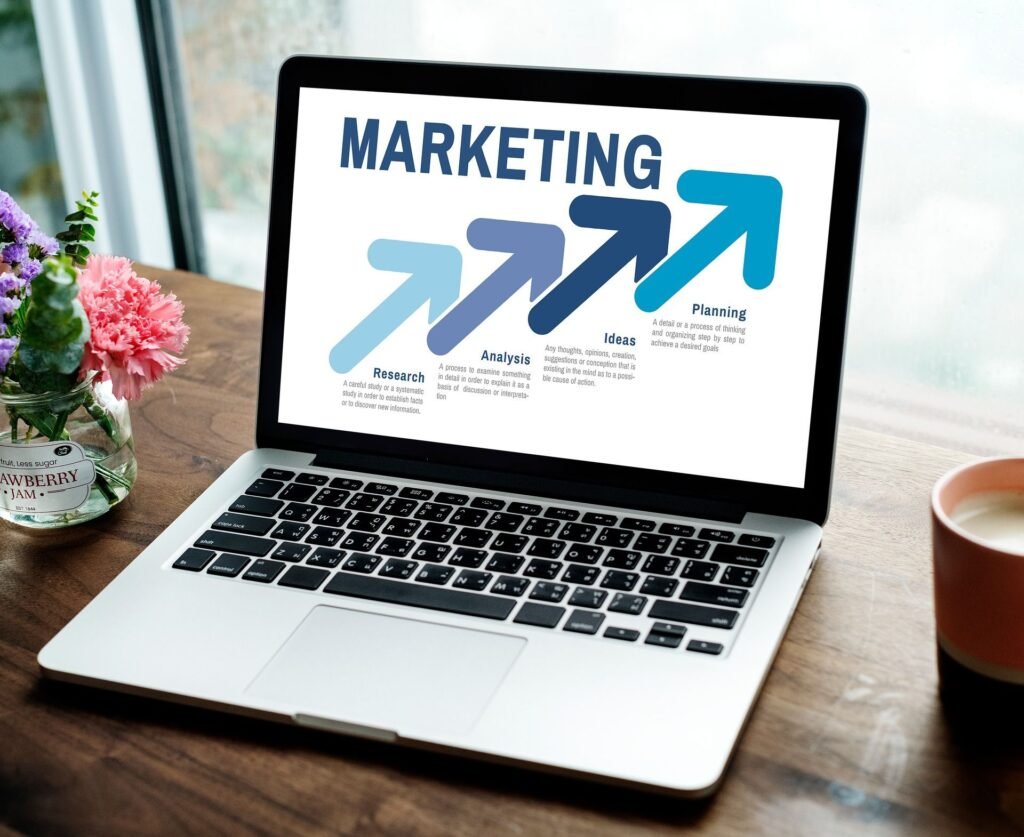
According to one of the most popular marketers in the world – Peter Doyle, the marketing is the business science that takes care of researching the market for a product, determining the necessary qualities this product must have in order to fulfil customer’s expectations, creating with the R&D department a prototype of this product, helping the production department produce this product and finally, help sales department sell the product to company’s customers.
The most important thing that most people don’t understand is that marketing in not only the department that advertises and sells the product together with advertising and sales departments, but the body that actually researches and creates the product and only then – advertises and sells it.
And this is an extremely important difference, which failing to understand could make the difference between a success and a failure of a product.
For big companies, it is clear that good research of the product that clients are looking for would produce a product that will sell immediately, because that would be a product that people actually want.
But imagine the implication that could have in a small marketing (or any other kind of service-selling company). Those companies usually have custom-made service products. They rarely have more than a dozen such products. In most cases the company just adopts and starts offering common services in the sector. But these products are a commodity. Everybody in the sector is offering them. Just like the orange juice and the milk. Same everywhere.
Now imagine what would be the difference if the company makes good research on the persona of their clients and offers them custom made products, specifically shaped according their taste? Practically, offering the ideal product for them? That’s right, sales will skyrocket.
Porter’s 4 p-s
One big part of contemporary marketing and business strategy comes from an American economist called Michael Porter. This is a guy, who started as an industrial economist in a plant. When there is involved a production, things are very simple. You make the stuff sell, or you die as a business.
Michael Porter created plenty of interesting frameworks and ideas and all of them have been proven to work for the last 40-50 years. Perhaps I am going to write some words about those frameworks in the future, because I really love them. They are simple, easy to understand and absolutely operational.
Here I’d like to have a brief stop on Porter’s 4 Ps framework. Because it is really in the heart of marketing – or how to make something sell.
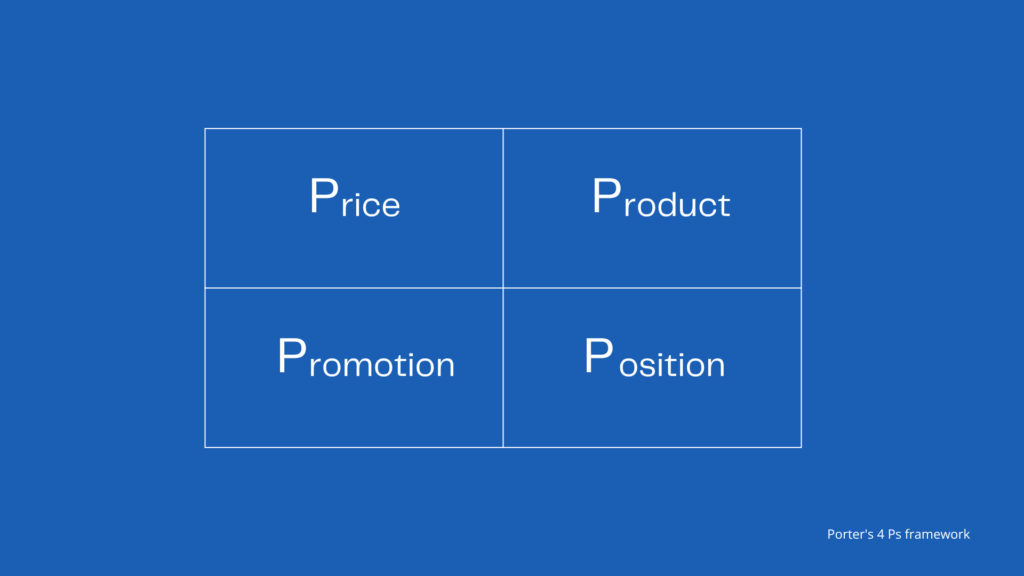
So, in his early career, Porter found out that any business depends on mainly 4 things:
- The type of Product you are selling, or the Product P
- The Price you are selling your product, or the Price P
- The Place you are selling this product on, or the Position P
- And the Promotion you are using to sell this product, or the Promotion P
In the past, Porter 4 Ps was a framework that guaranteed success on the market. If you had a good product (the one that your customers love) and you offered this product at the right price using the right promotion to attract your customers (to sweeten the deal) and your store was located on the right spot (where there were plenty of customers), so there was simply no way not to get your business successful, right?
You’d be surprised to learn, that today, even though the Internet has changed dramatically the conditions of doing business, Porter 4 Ps are even more useful.
Products you are selling are absolutely crucial. Products are in the core of some of the best-selling tools, like the sales funnels. To use a funnel, you need to have a series of products organized in a value ladder. We’ll talk more about that later in the section for sales funnels
Promotion is an extremely important aspect. Again, we’ll talk about that in more detail later, but here just know that promotion is in the core of any lead generation strategy, as well as in any sales funnel.
Price, obviously, need to be the right one. If you sell your products more expensive than your competitors, you’d have some serious troubles with the sales. If you sell at a lower price, you’d be losing money.
Finally, the Internet has completely eradicated the meaning of the Position. All of the e-commerce stores are located in that virtual global village we call the Internet, with no physical location. So, basically, any shop must have the same chances with the rest, right?
Well, the answer is not exactly. On the Internet, there is a huge lot of information and it is really difficult to understand where exactly we could find the exact piece of information we are looking for. Here come the Search Engines that take care of that problem. Principally, their task is to provide us the right information we are looking for.
It turns out that anyone could use a set of good practices on her web site by which her site could get better rankings in the SERPs (Search Engine Result Pages) and better rankings in SERP means more customers in her e-store. This is called SEO and we’ll talk about this more in the SEO section.
As you can see, Porter’s 4 Ps framework is one of the most important frameworks in the era of the Internet, even though it has been invented some 50 years ago. Especially for those that would like to run a smart business.
In conclusion
What’s the moral of this section? It is impossible to run a digital marketing business without using classic marketing principles. It’s not a smart way of doing business.
2. Web design
What is web design?
To sell something online, you need an online shop. To live in the digital era, you need a digital face.
Web sites are the technology that gives us all of these means.
Nowadays you can use web sites in hundreds of different ways. The website could be a static page type “business card”. It could be a store, where you are selling millions of products, It could be a marketing agency office, where you can see and choose a service to buy, it could be an automatic courses platform, it could be a dating site, it could be an online casino, it could be a dentist office, where you can book an appointment, it could be anything, literally.
You can’t do anything online without a web site.
That’s the reason websites are pillar No 2 in my digital marketing list. They are the alpha and the omega of digital marketing. It all starts with them and it all ends with them.
History
Web sites appeared a bit after the first appearance of the HTML language. HTML stands for Hypertext Markup Language and was invented in the beginning of the 1990s of the last century by some scientists from CERN in order to share their scientific articles. The project was known as WWW or World Wide Web.
Internet was even older as an idea. It uses the TPC/IP protocol, developed by the American DARPA Agency in the 70s of the last century as a means to provide secure communication between the military even in a case of just 2% functional nods. The protocol was created for a case of a Nuclear war. I won’t be entering in technical details, but the only thing you need to understand here is that the TCP/IP protocol is an extremely robust and reliable protocol.
On the base of these 2 projects, some years later appeared the Internet.
And since then, the world has never been be the same.
How the Internet works
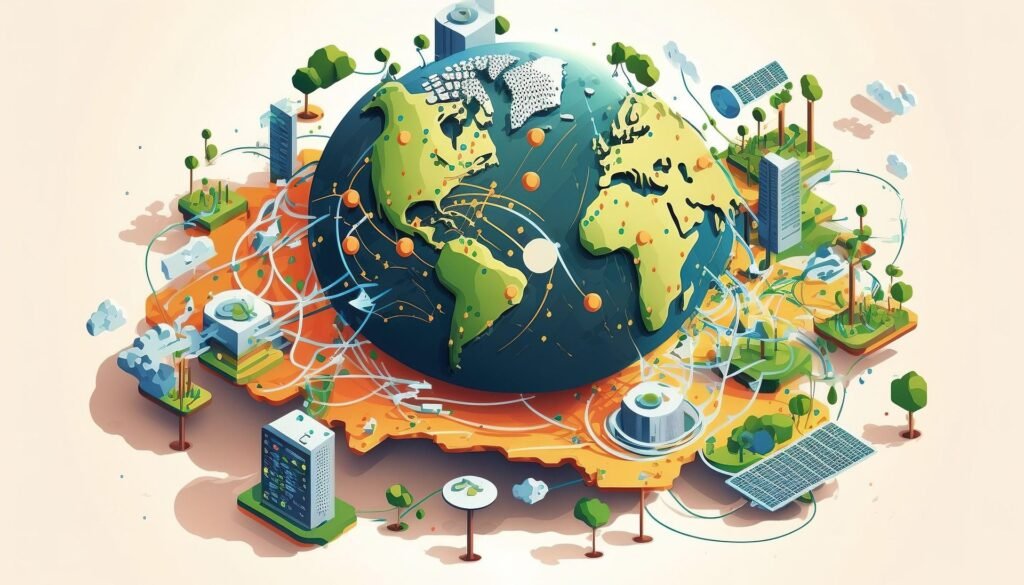
The work of the Internet is quite simple, actually. In a very simplified way, websites are bunches of interconnected files that are located on special web servers. We use browsers to get these files on our computers (or other mobile devices), which browsers download websites’ files from the web servers and present them to us in the way we all know.
Of course, things are a little more complicated, but this is the model in a nutshell. We’ll talk more about that when I show you how web hosting works.
To summarise: websites are hosted on web servers in a form of bunches of interconnected files. Browsers of the clients request those files from the servers and ultimately, clients access the information that is located on the web sites.
Content management systems (CMS)
Nowadays there are tons of systems for organizing a website. However, the most wide-spread ones are the so-called Content Management Systems, or the CMSs.
CMSs are software systems that are highly automated and allow literally everyone to build a site within hours. They are extremely secure, sophisticate and easy to use. Working with a CMS is very much like working with a word processor, one like Microsoft Word or Google Sheets.
Principle of the work of a CMS is also quite simple. There is a Backend of the system, where the content is put in by an operator and there is a Front end, where the customers use the web site (read news, book appointments, buy things etc.). The back end is also used to style the site, that is, to shape the way how the site looks on the Front end.
CMSs are based on a modular principle. This is the beauty of this system. It all depends on the functionality of your site. If you need more functions, you add the related plugins. For a simple site you need just a few plugins. For a more complex one – you add more plugins. There is a plugin for any functionality.
WordPress
One of the most popular CMSs is WordPress. There are different approximations according to which between 50 and 70% of the websites in the world are using WordPress.
This CMS started as a blogging software. That is the reason in its basic form, it has just a handful of plugins. What do you have in a blog? The only functionalities you need for a blog is an archive page for the posts, a template for the post pages, a possibility for creating web pages (in case you want the landing (home) page of your blog to be different than the archive page and a contact form.
I’ll go through all of these pages in the following posts, but for those who don’t know, for that functionalities you only need 5 or 6 plugins.
Nowadays, WordPress ecosystem offers a huge lot of plugins. There are thousands and thousands of plugins with which you can make a huge lot of different websites.
WordPress is free and most of the plugins are free. Of course, some plugins are paid, but the price is really bearable compared to the prices of the software we had to pay in the past.
I firmly believe that using WordPress for your site is a smart way of doing business. Because it is a cheap, accessible system, but most importantly, because it is extremely secure and easy to work with and there are hundreds and thousands of people who work for removing bugs and vulnerabilities from the system.
3. Digital advertizing

We are reaching two pillars that have always been part of the marketing and business. It comes to advertising. Today, with the appearance of social media, there is one more derivative of advertising and this is so-called organic profile development.
Practically, both advertising and profiles’ organic development are a form of advertising. Both aim to advertise the company and its products. There’s one huge difference, however, and this is that advertising is always considered paid, whereas organic profiles development is free.
Throughout the years advertising has been a business subject that’s been working closely with marketing and sales. Most of the majors of the business schools are called exactly that way – “Marketing and Advertising”. In fact, a lot of people confuse those two matters. This is especially true today, because in digital marketing those matters quite often overlap significantly.
No matter classic or digital marketing, the difference between those two is enormous – marketing markets the products, whereas advertising is trying to change the perception of the clients towards these products so they like them and ultimately – buy them.
4. Organic development

Organic development is relatively new concept. It appeared with the appearance of Internet Search Engines and Social Media.
Those two phenomena totally changed the world of marketing and business and are in the core of the digital marketing.
Social media in particular allowed huge masses of people to follow other remarkable in some way people. The social profiles of these influential people are usually developed in a natural, or organic way. Without having to pay for that, people just like the ideas preached by those influential people and naturally follow them.
Of course, businesses immediately noticed the opportunity and tried to seize it. This is how the influencers appeared (more about that in a while). The important thing here is that a new way of marketing/ advertising appeared. One, that you don’t have to pay for. At least, not in the traditional way of paying for advertising.
Perhaps, this could be compared (in a way) with the old “guerrilla” marketing methods from the past. “Guerrilla” means using asymmetric ways of marketing. These are methods where you pay less and get more. For example, such a method is the notorious “word of mouth” marketing.
Anyway, the concept of organic development is a new and extremely powerful way of influencing customers. This is why I am putting it as a pillar of the digital marketing.
We’ll talk more about paid and free advertising methods when we discuss the next two pillars of digital marketing – SEO and Social Media.
Organic development is one of the smartest ways of doing business. I’ll tell you how exactly to do it and profit from it in the following articles.
5. Search engines
When the Internet started to gain pace, one very significant problem appeared. Suddenly, a huge lot of data was available and customers started to straggle to turn this data into information. By definition, information is structured data, that is useful for us in some way.
For example, imagine you need a shop to buy shoes. The shop must be located around your place, so you don’t waste time. In the dawn of the Internet era, there were no ways to search the Internet content for such shops. Or whatever other information (structured data, useful for you) you needed.
The need for a mechanism for filtering the data in the Internet was obvious. And this is how the first Search Engines appeared.
There are plenty of interesting stories about the early years of SEO, but I am not going to tell these stories here. We will talk about that in the following up articles, the ones dedicated to the SEO and Search Engines.
Here, I am going just to tell you about the two ways of SEO optimization of your web pages. The process of optimization means to move your pages ahead in the SERP (Search Engine Result Pages) pages, so when people search for a product they need and you have it, they could see your page first.
As we talked a minute ago, there are 2 main ways of doing that.
Search Engine Optimization – SEO (Organic)
The organic way of doing that is called SEO or Search Engine Optimization. SEO is using a set of good practices to structure your web pages in such way, so they appear in the first results of SERP.
SEO has 3 pillars by itself. This is the Technical SEO which takes care of all of the technical issues of your site, the On-site (or On-page SEO), which consider the content of your page and finally, the Off-site (or Off-page SEO), which considers what is happening outside of your page or generally, how people like your pages.
Your page has chances to appear on the head of the SERP if all of those pillars are well designed and set up for your pages. In general, Google thinks that if all of the conditions above are met, your page would provide value to your customers.
A very important note here. The business models of all Search Engines are based on the presumption that they will provide the best value for their customers. ALL of the SEO algorithms do is to provide value to the customers.
On the other hand, there are plenty of businesses that try to cheat the Search Engines by curve fitting the current Search Engines algorithms.
NEVER try to cheat the SEO algorithm. This could work for a while, but in the end, Search engine will catch you and your pages might turn out of SERP forever.
My way of doing SEO is to ALWAYS try to provide value for the customers. ALWAYS. So, when you create the content of your page, ALWAYS think first to solve your customers’ problems. And just them, think for the algorithms.
I have prepared a spacial page dedicated to the classic SEO. You can have a look at it here.
Generic Engine Optimization – GEO (a layer of artificial humanity)
With the appearance of the AIs some 3 years ago, a totally new layer of SEO was added to the rest 3 pillars. They refer to it as a Generic Engine Optimization, or simply – GEO.
In the SEO circles there is a HUGE misunderstanding about this new pillar. Many, many people dealing with SEO think that the GEO is an SEO optimization made by an AI. As a result, a mass practice now is to ask an AI to make an optimized text on a certain topic and then to copy/paste that text in the page meant to be optimized.
And this is SO, SO WRONG!
Search Engines want their clients to be served in the best possible way and they know pretty well that AIs just imitate humans and the content generated by them is nothing else than a “robot” content, ingenuine and not suitable at all for their customers. In brief, the value from AI generated content… is not high.
That’s the reason that most of the AI generated content, sooner or later ends outside of the SERP results. Not in the middle, just outside. Be very careful when hire such “GEO” experts.
Search Engines actually use an AI to ANALYSE and to CORRECT the SEO algorithm in such a way, so it suits the best way the Search Engine customers. This is to say, the GEO actually add a “human” layer of analysis to the algorithm. To analyze and provide the best value to their human customers.
Search Engine Marketing (Paid)
SEM stands for Search Engine Marketing and is the paid version of SEO.
SEM is part of the business model of any Search Engine. These companies provide free search for a huge lot of people and give meaning to the Internet. The way they pay their bills is by charging some companies that don’t have products in the top SERP results to put them there.
I think most of you must have seen these results – they are on the top of the SERP page, next to it or below that page. Any such result has a clear sign “Sponsored” for the clients to know that this is paid advertising.
A lot of companies use paid advertising in the SERP results. The best practice is to use both SEO and SEM.
There are may sites that one can get additional information on SEO, but I highly recommend to use MOZ. This is an amazing web site where you can find the latest development in the area.
A few words in conclusion about the Search Engines
Dealing with digital marketing is ABSOLUTELY IMPOSSIBLE without using Search Engines. That’s why I am going to say here that anyone who use both SEO and SEM is a smart businessman. Those that don’t use it… simply don’t exist in the digital world.
SEO is a great way to apply different asymmetric strategies for growth. ANY asymmetric strategy is a smart strategy. This is when with limited resources you achieve huge results. That’s the reason, I love any kind of SEO strategy. We’ll talk more about these ways of doing business in the next articles.
6. Social Media

First social media appeared some 20 years ago and since then, they have become one of the major innovations of our world.
We, people, are social beings. We always tend to gather together ever since the stone age, when our predecessors used to sit in the dark around the fires in the caves. We love meeting other people, chatting with them, gossiping, exchanging news, partying and overall, having fun together.
The invention of the Internet, the smartphones and social media created a whole new layer in this obsession of ours. According to the statistics, anyone of us spends at least an hour a day in social media. Using our phones, from the comfort of our armchairs, doing the same old things – chatting, gossiping, having fun together.
Of course, businesses have spotted this as a golden opportunity to enlarge their reach to new customers and respectively, for some additional profits. This is how we ended with all of those ads in the social media, as well as with all of those stories, told by different influencers. These are all ways business want to reach us and attract us to their stores.
Again, like in the Search Engines pillar, there are 2 main ways business advertise in social media. There are the organic development of social profiles and paid advertising (know in the branch as Pay Per Click (PPC)).
Organic profile development
Organic development of social media profiles is another asymmetric (thus smart) way to create awareness amongst your customers and ultimately, to attract them into your web site.
In the beginning, social media tended to keep things conservative, allowing only contacts between people that know personally each other. However, with time, the managers of those media understood that their strongest asset is the interconnectivity. So, they started to promote posts of different popular people in the media, according to your interests.
For example, in the early years of Facebook, there was a limitation of 5,000 friends per profile. During this time, we could see in our feeds only posts (or reactions) of our friends. Now, along with the ads, there are posts from different influences that the algorithm believes you like, post marked “suggested for you” etc.
There is also at least a dozen of different types of profiles, in addition to the personal profiles we’ve been using.
All of these changes allow for businesses to develop organically profiles, by which profiles to attract fans. If done properly, anyone could collect a really huge base of followers. We’ll learn how to do that in the following posts. There are clear rules, which by following firmly anyone can achieve success. These rules differ from media to media.
Paid development (PPC)
Paid advertising in social media is exactly that – you pay to the media for posting your ads in the streams of other people.
From my observations, using paid advertising in social media pays back any dime. Of course, you must do that in the right way and this is exactly the spot where huge lots of people fail.
Why do they fail? The reason surprises many people. They fail because… it is extremely easy to post ads in social media. But, wait a second. Doesn’t “easy” make it better for the people to succeed? Well, yes, and … no.
When it is easy, everyone can post an ad for minutes. Without understanding 2/3 of the options in this ad. The ad gets published, everyone feels huge enthusiasm. In the end… the results are disgusting.
In order to succeed with social media ads, you need to understand ANYTHING of what you are doing. Any single letter, any coma, any point. There shouldn’t be ANYTHING you don’t understand. A comma could be the difference between a success and a failure.
We’ll talk more about ad campaigns in the posts to come.
A few words in conclusion about Social Media
Just like Search Engines, Social Media is absolutely indispensable for the digital marketing. There is just one option here – using social media is a smart way to do business. Not using social media – there is no digital marketing business.
The smartest way of using Social Media is again, like in the Search Engines, a combination between paid and free methods.
The Paid advertising is used with huge success in some of the most powerful methods of digital marketing. A great example of such use are the sales funnels, which I have summarized as pillar #10 of digital marketing. We’ll talk about that in a while in the section about the sales funnels.
7. Content marketing
History of content marketing
I remember the time when the Internet didn’t exist, the email didn’t exist and we all used normal mail (paper sheets where we wrote with a pen and then put these sheets in a paper envelope). At that time, our mail boxes got full of spam in a form of different leaflets. Every day, when I came back from work, I used to empty my mail box. Get the useful letters and all of the rest I used to throw in a special spam box.
At that time, I didn’t understand much of marketing and I was wondering why they used to send us so much spam, when everyone (just like me) used to throw that spam away.
When I started studying in the business school, I was absolutely shocked. It turned out, that in the early days of mail marketing (the one with the paper mail) nearly 7 percent of the people opened all of the spam. And quite a big part of these people used to buy later some of the advertised products.
The change
With the appearance of the email and email marketing, that number started to decline. Slowly in the beginning, and quite step in the years to follow. To reach 10 years later the number of 0,002 percent opening rate. I took some efforts to calculate the change. It was 3,500 TIMES less. Or 350,000 percent. Can you imagine that decline?
What could possibly be the reason for such a change?
Well, it was a complexity of factors. The marketing automation allowed for anyone to send promotional emails. Anyone could buy a list of a few millions of email addresses for just a couple of hundreds of dollars and to start spamming immediately. There were no laws regulating email marketing and not allowing spam.
As a result, people got tired being flooded by ads. They simply stopped paying attention to all of these “attractive” and “exclusive” offerings, knowing that very few of them actually were bringing any value.
The solution
So, marketers needed to start looking for a solution. And what they found was the content marketing.
To put it simple, content marketing is a marketing where you hide the marketing message in some person’s story.
For example, I am a well-known blogger with millions of followers. I write about cars and people really like my articles. One day I get approached by an expensive car producer, who wants me to write a story about their cars. I have to tell my readers a nice story how I just bought one of these cars, how I traveled with it and how wonderful this car is.
As a reward, the car company is paying me a huge lot of money.
The next day I am publishing the story and the following month lots of my readers buy some of these wonderful cars.
This is content marketing. The car company and I hid the marketing message in my story and it became much easier for the customers to absorb this message. It was not the irritating ads on the TV, the spammy emails, the disgusting pop- ups of the screen ads. It was just a story one person tells the others. A story they like.
Suddenly, there were plenty of “content creators” that appeared. You could see bloggers, vloggers (video content creators), short form creators (videos no longer than 60 sec.), Influencers, UGC creators and so on and so on.
I am going to describe bellow some of the main types of content creators.
Blogs
Blogging is perhaps the oldest form of content marketing. In the beginning, there were famous journalists who used to write daily columns in some of the most popular journals. Those people were really good at writing and had hundreds of dedicated readers. People who followed them and read any new article written by them.
With the development of the Internet and the appearance of specialized blogging platforms like Blogger and WordPress.com, anyone could open a blog, practically free of charge. A lot of people started blogs and not surprisingly, some years later, there were many high-quality bloggers who produced tons of new content every day.
There were already more sophisticated ways of monetisation and the content marketing advertising started gaining speed.
Vlogs

With the appearance and further development of video platforms like Youtube and Vimeo, all that already existed in the written world, transfered to the visual world.
Vlogs are very similar to blogs, but they use video as a form of communication.
Video has many advantages to the written articles. It is perceived much easier by the consumers. It can convey the ideas much clearer and it can reach much larger audience because not anyone likes reading, but almost everyone likes watching and listening to interesting stories.
With the development of the short forms of video content the quantity of the vloggers literally boomed and now there is an entire universe of video content creators, including influences and UGS creators.
Influencers

With the development of social media, a new breed of marketing animals appeared. The influencers and the UGC creators. Influencers are usually young people with a huge fan base. Those people managed to influence a lot of people, to make all of those fans subscribe for their social channel and to follow them on these channels.
They influence people. Hence – influencers.
Influencers gave birth to a whole new branch of marketing – influencer marketing. There are platforms, where a marketing manager of a company can go and find an influences of her taste and hire them for a marketing campaign.
UGC Creators
UGC creators stands for User Generated Content Creators.
The UGS creators are very much like the influencers with one tiny difference. Their fan base is not so large like the one of the influences.
As a consequence of that, their wages are much lower than the ones of the influencers.
Even though influencers and UGS creators are very different advertising tools, there is enough work for both segments. And a lot of marketing managers use them in their work.
Content marketing is a smart way of doing business today. It allows for creating some asymmetric market strategies and as we already know, in marketing asymmetric is good.
8. Email marketing
To be honest, for some time I didn’t use email marketing. It all came with those huge spam marketing campaigns we all witnessed. The results from email marketing campaigns were low and I simply didn’t believe this tool would come back ever.
Still, for the last 10 years things have changed. Social media platform started offering special lead generation campaigns, a lot of wonderful tools for lead generation appeared and as a result, people stopped using those disgusting spammy email lists and started creating their own lists with their persona customers.
That changed the results drastically. If you use your own, organically built email list, you can reach an opening rate of 60, sometime 70%. And HUGE engagement rate from your customers.
Today, email lists are built in special email platforms like MailChimp. These are very sophisticated platforms that offer plenty of functionalities. For a small amount monthly, you can create and post on your site lead generation forms, you can created mail lists, you can give to your customers the option to unsubscribe from your list (which is required by the regulations in many countries) and many other interesting things.
But the most important thing that you can do on these platforms is that can communicate effectively with a huge number of your subscribers using marketing automation.
We’ll talk a lot about email marketing in the posts to follow because today this is one of the best instruments in the toolkit of any digital marketer.
There are mainly 2 ways of using email marketing: Email campaigns and Marketing automation.
Email campaigns
Email campaigns are the basic way that most people know. This one is the simpler method of communicating with your customers.
In the marketing campaign you just send an email to all of your customers. As the name suggests, the purpose of the campaign is to try to sell a product or a series of products to your clients.
How exactly this happens? You prepare your products, make a special offer, prepare a landing page and simple funnel, or just use the link from your e-store. You then prepare the email itself and then mass send it to all of your contacts. It is that simple.
If you have a good mail list, one that you have created organically and most people from the list know who you are and like you and your products, there are pretty high chances for you to have a good campaign.
Unfortunately, this is the way most spammers use email marketing. If you have bought your list on the dark market and you use a spam software to distribute your email, then you are a spammer. First, your campaign would have some terrible results and second, you risk some serious troubles with the authorities. Spamming is forbidden in most parts of the world.
We’ll talk about creating mail lists and what are the best ways of doing that in the posts to follow.
Marketing automation (email automation)

Marketing automation is a much more sophisticated method for email marketing. For certain, this is a smart method for doing digital marketing business and it is one of the best tools for small companies.
Why? Because it’s been used in sales funnels. I marked sales funnels a pillar #10 of digital marketing, because this is a must for any small business. I’ll tell you more about sales funnels in a while, but for now just remember you can’t use sales funnels without marketing automation.
As we talked, every e-commerce businessman or businesswoman must have a mailing list of his fans or his customers. This is absolutely crucial, because any business relies on repeated customers. There is specific term in digital marketing – customer lifetime value. This is not how long live your customers, as some can expect. This something other, much more important for you and your business.
Customer Lifetime Value (CLV) is a metrics that measures how long your customers stays with you and how much money they will bring to your store for that time.
Good communication with customers can significantly raise your customers lifetime and respectively, their CLV.
But what exactly is marketing automation?
Marketing automation is a software that allows you to create lead generation forms, to collect your customers’ data and store it in a structured way, to organize marketing campaigns and produce workflows.
Lead generation forms are forms that are specifically created to collect the contacts of your leads (potential customers). We’ll talk about that in more details in later posts, because there is so much to be said on that topic and this is something absolutely fundamental for digital marketing.
We use platforms of the sort of MailChimp and Omnisend to organize our customers data and to communicate with them.
We already talked about the basics of marketing campaigns.
Workflows are perhaps the most interesting thing of the marketing automation. This is a software that can organize the whole communication with your clients with very little personal involvement from your side.
This software can trigger a workflow for any particular customer you have. It can send different emails, which are prepared in advance. It has logic blocks that can decide when and what emails to send to the clients and finally, it has delay modules than can send these emails at the time of your desire.
All of the above allows you to create powerful detailed communication models with different segments of your clients and ultimately to make your business blooming.
All of what I now told you is just the basics of digital automation. There is software that allows to organize extremely complex workflows using dozen of communication channels like Whatsup, SMS, phone calls, different messengers etc.
In conclusion about email marketing
Email marketing is also something, without which you simply can’t run any kind of digital business. It is a must. It helps you create a list of your customers, organize this list, analyze the behavior of your clients, create segments between them, organize different marketing campaigns, create effective workflows end many other useful things.
Email marketing allows you to communicate effectively with your clients and raise their lifetime expectancy.
I have seen lately some platforms even offering predictive analysis using AI, based on the past data from your store or the previous behavior of your clients. Pure magic…
Yes, using email marketing and marketing automation is a smart way of doing digital business.
9. Artificial Intelligence (AI)
Introduction
Functional AIs appeared just 3 years ago but they have totally changed the digital marketing landscape. We used to talk about the “Generative AI” in the very beginning, where the AIs used to accumulate information. Now we are listening about AI agents. More than half of the content on the Internet is already created by AI.
We can hear that “the robots are coming for our jobs”, that “soon there will be no more human labour”, that “we’ll get retired poorer than we started our work path”.
There is a big misunderstanding when it comes to AI. A lot of people just don’t get it and have really high expectations.
So, what is really the AI?
What is AI
A very long time ago my major in the engineering school was exactly AI.
Funny thing, at that period, our professors had forbidden us to use the term AI. The technology was in a really early stage and the base of the AI at that point was totally different. All of the academics in the area at that time firmly believed that the AI would be based on neural networks.
Knowing the principles on which our brains function, scientists believed the AI would use the same principles. So, there was a special software that emulated a simple neural network that needed to be taught (trained) to work in the way we wanted.
This is exactly what me and the other students from our group were doing. We were teaching (training) a 5 cells neural network. We trained that system to control an electrical motor system of a few motors. The training took 7 days of PC time and at that point we were using an extremely new and super expensive PC based on an Intell Pentium processor. It was the Spring of 1994.
The computer cost thousands of dollars, we had to book the computer time weeks in advance because there were plenty of other students that wanted to use this super machine.
Any of us knew that in fact, there was not an AI, just a bunch of algorithms programmed to perform some tasks. Theory was there, we studied adaptive systems (the equivalent of today machine learning), fuzzy control and a whole lot of other functionalities of the AI. Still, the technology didn’t allow us to do anything meaningful.
Since these times, the technology has improved dramatically. There are now huge data centers, the processor power is thousands and thousands of times higher compared to the past, the RAM and ROM memories are way ahead, both as capacity and speed. Processor and computer architecture have changed, today the 3 nm chip technology is the main one, something unthinkable for the past.
The theoretical base upon which lays the new AIs also changed. Contemporary AIs are based on something called Large Language Models (LLM) and are much more powerful than the AIs from the past.
Still, little has changed in the core of the AI. It is still a bunch of algorithms, even though much more sophisticated than the ones 30 years ago.
So, just like the father who disappointed his kid telling him that there were not any clouds in the computer cloud space, only interconnected Linux servers, I’ll have to disappoint you that there are not any AIs on the Internet, just some bunches of interconnected algorithms. Extremely sophisticated, using a cutting-edge technology, but nonetheless, only algorithms.
We don’t have fellow AIs soulmates yet. These are just robot.
After we agreed as to what are today’s AIs, we move to the analysis how we could best use them.
How to use AI in the best possible way
After we know what AI is, it is very easy to see what we can use the AI for and what we can’t.
In very brief, AI is a robot. As a robot, it does well everything that robots do well. And these are boring, monotonous tasks that are prone to automation.
For example, your can create an AI agent and task it to call all of the hotels in the area and to find the right one for your marriage. There was a viral short on this exact topic representing 2 AIs talking through the phone about that exact problem.
You can also create an AI agent, ask it to create 10 ads on a certain topic, open a Facebook ad campaign, tests those 10 ads, choose the best 2 of them and report to you once it has the results. With the current technology this is doable and actually could replace the work of a few professionals in a marketing agency.
What you can not do is asking the AI to create some tasks that requite a pure human interaction. For example, AI can’t create you a good article on a specific topic. In most of the cases, it would create something that sounds extremely well… and nobody will read after that.
You can’t expect from the AI to think for you. Because the machines can’t think yet. Perhaps in the future, some day. But not today.
The way I use AI is by asking it to generate initial research on some topic. This is extremely time consuming and this task is something I start any new project with. I found out that AI is extremely good at doing such research.
Later, I am going to research and develop any of the points the AI has given to me and further develop the topic.
I also like asking the AI for headings of my content. From a copywriting point of view, the heading is absolutely crucial for initial attraction of customer attention.
I usually ask the AI to give me a dozen of headlines. After I go over them, I choose a heading that is a combination of the headings, given me by the AI.
The reason I do that is because the AI has a huge database of such texts and more importantly, the AI has very good statistics as what works well and what doesn’t.
I also like using the AI for generating specific pictures for my posts and thumbnails.
In conclusion about AI
AI is a new area of the digital marketing. The development is extremely fast – everyday new AIs appear, anyone of them with new possibilities.
AI is a robot. It is not intelligent like us. It only emulates intelligence. For that reason, for the moment, AI is only good at performing heavy, monotonous tasks that are prone to automation.
AI can’t think.
Yes, AI will take a lot of jobs. However, it will not be able to think the way we, humans, think. That’s the reason, from people will only survive these, who learn how to harness AI power and make it help them to do faster and better their job.
But the most important conclusion is that if order for the AI not to take your job, you must learn how to use it.
AI is the future and yes, it is a smart way of doing digital business. But be careful, it could turn very easily into a huge disadvantage.
10. Sales funnels
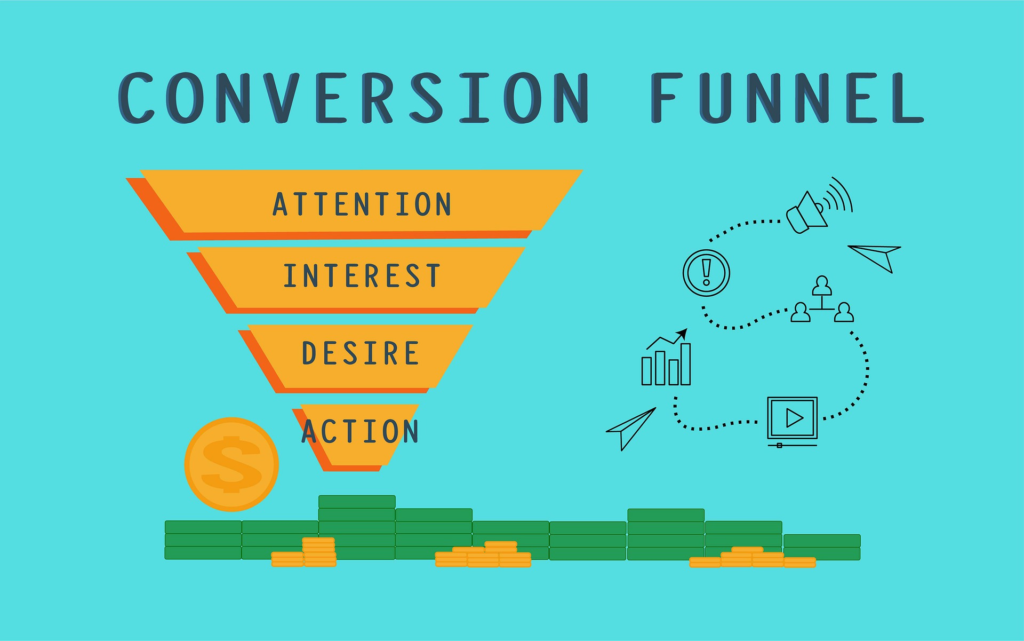
Sales funnels are something I discovered a few years ago. And since the first day I knew about them, I am absolutely in love with this thing.
What are sales funnels?
In very brief, any funnel represents a series of webpages that are connected between them in some way. The entry of the funnel, or the first page is called “landing page”. On this page it is usually offered a product in promotion. After the landing page there are a few more pages offering additional products. The offers in these pages are called upsells, when they offer more expensive products or downsells when they offer cheaper products.
The funnel ends with a payment page, followed by a “Thank you” page.
The entry of the sales funnel is usually from ads in social media.
A lot of people confuse sales funnels with marketing funnels. They are not the same. Marketing funnels is an old concept in marketing that represents a classification of your customers based on their customer’s path (this is the stage they are in turning from prospects to actual buyers).
We’ll talk a lot about both marketing and sales funnels. Although different, they are both extremely important for the success of any small business.
How the big ones do it
The retail is a very old industry. According to economics, in old industries there is nothing exciting. Margines are low, competition is huge and it is extremely difficult to do business in this environment.
This is the reason retail companies have invented plenty of tactics how to deal with the huge competition and low margines.
I won’t enter in details here, but one of the best-working tools are the promotion campaigns. Every week, the retailers offer a promotion on certain group of goods. The margin is zero and the price becomes really attractive. That attracts customer to buy those goods. There is a huge lot of tricks from social psychology applied in these campaigns.
Retailers know that it is in human nature for customers along with the promoted goods, to buy some other goods once in the store. And the retailers make THESE GOODS to be with big margins, so when the customers buy them, retailers compensate for the zero margin of the promoted goods and even make profits.
This explanation is very simplified, of course, in reality things are significantly more complicated. However, this is the general principle.
How the small ones do it
Small companies don’t have the financial and physical possibilities of the big companies. What small businesses usually do is selling their product by directing the customers to their web sites using either paid ads in social media, or paid ads in Search Engines. In some rare cases, if the site owner has done some good site optimization, there are people coming from well positioned pages in the SERP results.
The paid ads are expensive and the goods become extremely costly for small owners who are using this method. Not surprisingly, with time, many of them are forced to close their businesses.
But is there anything to be done, so the small guys could compete successfully with big ones?
Yes, there is. These are the sales funnels.
How sales funnels make this even
Sales funnels are the magic that makes small and big companies competitive. What a sales funnel do is to adapt the tactics of the corporation with the promotions, the one I explained you above to the small shops small companies have.
Sales funnels allow stores with even a dozen of products to attract customers with a promotion and then sell them a couple of upsells or downsells, where the small business can make its profit.
As I already said, sales funnels are perhaps my favorite part of digital marketing. I know I lot about them, I’ve been using them extensively for the last few years. This is really something that works, of course, if used the right way.
Sales funnels could be many different types. There are lead generation sales funnel, there are sales funnels for services, there are sales funnels for different goods. There are sales funnels for low end goods and there are sales funnels for high end goods.
There are different ways of using sales funnels. There are technologies that allow using WordPress and Woocommerce based websites, there are technologies using different sales funnels platforms.
I am going to tell you everything about sales funnels, the specifics of the creation of each and every one of them, as well as the pros and cons of the different approaches to sales funnels creation.
In conclusion about sales funnels
Sales funnels is perhaps the smartest tool in the digital marketer toolkit. They are a great way of doing business, particularly by small players on the market.
Sales funnels make chances equal for small business and big businesses.
Working with sales funnels is fun.
In conclusion about digital marketing
Wow! It has become one huge article!

If you have reached that far, I congratulate you! You already know everything about digital marketing! You also know what are the principle of the smart way of doing business!
In the following posts I am going to tell you lots of practical ways of applying all of the principles above. I am going to show you different solutions to different business problems, as well as different approaches to specific parts of digital marketing.
I am going to show you some free solutions, for those who have just started their path in digital marketing and some paid solutions for people who already are on this road. One thing I learned for digital marketing was that in many cases you get great value for things you buy for your business.
Free platforms like WordPress have made it possible prices of the software to become absolutely affordable and this is one of the best things for the contemporary ways of doing business.
Some more bout me you can find on this page.
How exactly I am going to use digital marketing to teach you how to do business the smart way you can find here.
Thank you for coming to my site! Let’s go learn some digital marketing!