

Table of Contents
Introduction
In this article I am going to describe the classic SEO. I am going to tell you about what it is, how it has developed through time, what are its main components, how it works, what you need to do in order to improve your ranking.
I am going to also tell you why SEO is now dead.
Finally, I am going to tell you what replaced the SEO and why the classic SEO is now necessary, but insufficient condition for the visibility of your website on the Internet.
History

The history of the SEO is short… and in the same time, really, really long.
With the appearance of the Internet with tons of information on it, it has become obvious that there would be necessary a system that would be able to index that information and help people find the one that they are looking for. A system, very similar to the index system of the libraries.
And the first search engines appeared. Of course, someone had to pay for those systems. There were two main ideas how to do that.
The first one was to make anyone who was looking for information to pay for that information to the search engine.
The second one was to find some other business model that could make the mass search free and to find anther way of getting paid out.
One of the most important problems to solve for the search engines was to provide the most valuable information for their customers. So, they started creating different algorithms which were meant to filter and sort the available information according to its usefulness to the customer and present it to the users starting with the most useful one. The first SERP were born.
Then an idea sparked. What if your information was not so useful, but you still wanted your page on top of the SERP results? Would you pay to the engine, so they post it there?
It turned out that many people were prone to pay.
The business model was born. On top of the SERP pages we could already see several results with a tiny “Ad” text on it.
The competition to get your page on the top of the SERP without paying was huge, especially in some sectors like finances, retail and different expensive services. People started to ask themselves what to do in order to get their pages ranked higher. It turned out, that if you follow some set of good practices provided by the search engines in the form of guidelines, it was possible to improve your page ranking.
The SEO was born.
The Endless Game

In the beginning, it was the idea. Then the first algorithm was created. The algorithm was imperfect, but it used to provide results to the users.
Then, there were some people who wanted to exploit the system and to add on the top of SERP their pages. Bad pages, quite often – fraudulent. Users suffered, search engines suffered too, because they started losing users’ trust.
Then the search engine changed the algorithm, so to close all the vulnerabilities and kick out the free riders. All spotted abusers used to be permanently banned from the platform of the search engine.
Then, there were new abusers who exploited the new search engines’ algorithm. Search engines stepped in and updated one more time the algorithm.
Then, there were some other abusers who exploited the new algorithm. And the search engines countered them again.
This is the eternal game which is still going on. Bad people try to exploit the system, search engines try to counter them. Meanwhile, the algorithms become more and more sophisticated, the searches become more and more precise, the hackers – more and more savvy.
There are more than 400 updates yearly in the major search engines. There are a few big updates and hundreds of minor ones.
Why search engines are so strict with the abusers of the algorithms? Reason is really simple. The quality of the search is in the core of search engines business model. If the search returns bad results, users are leaving and search engines go bankrupt.
Now, when we know the basics, let’s go the main question.
What Is SEO?

Here is my definition of SEO:
SEO is the free way of getting your pages on the top results of the Search Engine Result Pages, or SERP. This could be achieved by following a system of good practices, making your site a valuable source of information for your customers. SEO is organized around clusters of key words you have a strong expertise with.
Let’s have a deeper look at any of the elements of this definition.
Free Way
The SEO is free per se. You can hire a specialist or pay an agency to help you optimize your site. However, you don’t pay the search engine for that. If you know how, you could optimize your site by yourself and you are not going to pay a dime for it.
On the other end of the searching scale is the paid search, known as the Search Engine Marketing, or SEM. Here, you pay to the search engine to place your pages on the top of SERP with a small “Ad” next to the result.
As we mentioned it already, this is the way search engines make money. They provide their customers with useful information through free search and pay their bills by getting money from people who want to pay for their pages to get on the top of the results.
Getting On Top of the SERP Pages
Anyone of us who has searched at least one thing in Google, Bing, Yahoo, or any of the other search engines knows how this system works. You put the words you are interested in in the search bar, hit enter and in a matter of milliseconds you get the most popular results.
For example, you put “best bike shops around me” and you get a series of webpages with bike shops around you. That series of pages is called SERP.
Undoubtedly, getting on top of the SERP brings tons of benefits for those that are there. Lots of visits, reputation and most importantly, leads, who turn in customers, which ultimately means more money.
System of Good Practices
Through time, providing valuable information for their customers has always been the ultimate goal for the search engines. We already talked about that. To find the most adequate answers to the questions of their customers, the search engines have developed different algorithms.
The classic SEO includes 3 main pillars to assess the value of the search results.
First, the search engines have decided, that the best sites must be technically sound. That makes sense, since you can’t expect from someone with a technically messy website to provide you with adequate information. So, the first location the search engine look at is your site. If it is not technically sound, you lose points and don’t get on top of the SERP.
This is known as “Technical optimization”.
Second, this is the content of the site. This is perhaps the most important pillar of the SEO as it is directly connected with the reason the customers are coming to you. This is called “On page” or “On site” optimization.
The content must be presented in a clear and concise way and must be true.
Also, it must be presented in a way, that makes it easy for the customers to read it. There must be a logical structure with a table of content, you must use short paragraphs, the key words must me with certain density, there must be a clear set of subordinated headings – H1, H2, H3 etc.
Finally, one of the Google creators – Larry Page, has created something called Page Rank. This is a system of assessment the authority of any page on the Internet. This system ranks from 1 to 10 and is based on the backlinks that any of these pages have. In brief, the idea is that the most backlinks point to a page, the more authority it has.
This is known as “offsite optimization”, or optimization that comes from “outside” of your site. From other sites.
For the last few years, one forth pillar has appeared. In the SEO circles they call it “Structured data”. This could be added to the technical SEO, but in fact, it is a bit different.
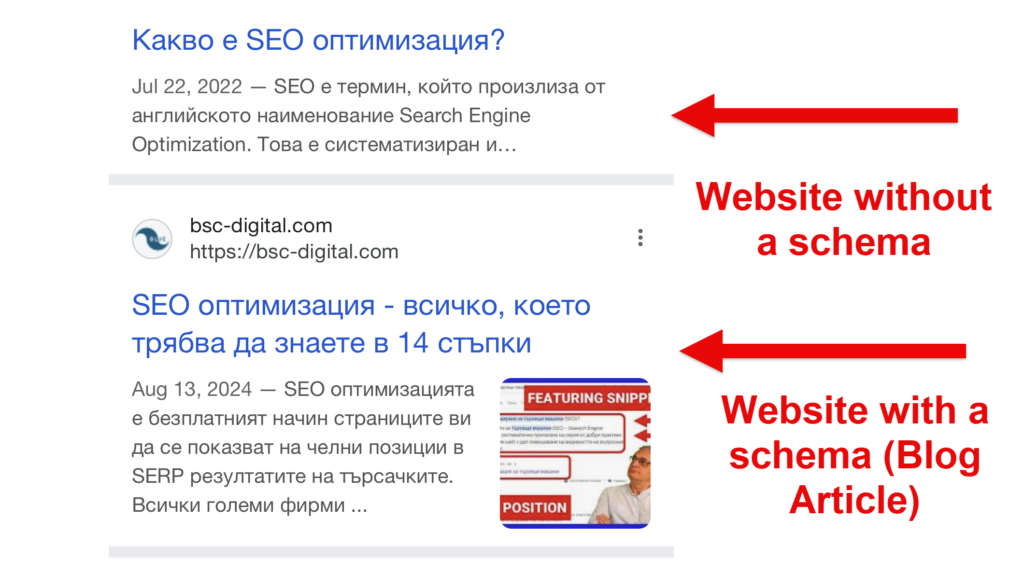
What is the “Structured data” pillar? It comes to something called schema. In the web design, you can hear about the schema either as “Shema markup” or “Structured data”. This is a way to organize the information about your company in an understandable way for the search engines. Once the search engine gets that information right, it presents it in a structured way in the search results.
Screen shot of a structured data from SERP
For example, the search engine could add a picture next to your information, it could add also work hours, video, and any other information, relevant to your business.
There are many types of schemas. To name a few, it could be for blog article, for video (in case you have a video on your page), it could be for e-commerce shop, for a dentist practice, or dozens other cases.
To summarize:
The search engines system of good practices includes 4 main pillars:
- Technical SEO
- Onsite SEO
- Offsite SEO
- Structured data
Valuable Source of Information
The information you have on your webpage must bring real value to your customers and respectively, to the customers of the search engines’. You can’t just put together some text and try to optimize it later for SEO.
You must always start writing your copy with the idea of fully satisfying your customers.
We already said this in the beginning, but I am going to out it here once again.
When it comes to search engines and SEO it is extremely important to understand one thing that is absolutely crucial. The business of the search engines depends entirely on the quality of the provided information.
It’s really simple. You provide your customers with a valuable information, they are happy and keep coming. You provide them junk – they leave. You lose customers and get out of the business.
That is the reason that all of the search engines are absolutely merciless when it comes to quality of information.
This is especially important when it comes to deal with people who want to cheat the algorithm and make the search engines provide false or bad quality information to their clients. It’s the biggest sin you can have in relation to a search engine. It could get you a permanent ban to the SERP. I’ll discuss this game in a while and I am going to give you a detailed answer why it is so important not to cheat the search engines.
Tu summarize – the information you provide in your website must be valuable to your customers.
Clusters of Key words

The whole system works by ranking your page in regard to certain key words. In the SEO universe, a word is not exactly like the word from the plain language. The SEO word very often consists of several normal words. For example, a SEO word could be “best restaurants around me”. Of course, it could be just “restaurants”.
The more words there are in a SEO word, the more specific is the query. The SEO word that consists of several words is called a “long tail word”.
Long tail words have lower volume, but are more specific and acquire better quality customers. People who know what exactly they want. In that regard, they bring more conversions and ultimately, more money.
Any web page is optimized for a cluster of words. The cluster of words is a set of SEO words that usually go together thematically. When a SEO project starts, it starts with research of all possible SEO words specific for the optimized page. Later, those words are grouped in a cluster.
Strong Expertise
It goes without saying, that you need to show strong expertise in your web page. Here, you need to apply some of the academic rules of writing an article. In academics, everything you say must have a proven base. You need to say why it is that way and this is usually done with citations. Failing to add citations in academics could bring you accusation in plagiarism.
Plagiarism in academics is when you use someone else’s work without paying the due to this person’s work. It’s like stealing the work of other people. In academics, this is a mortal sin.
Writing in web pages is similar. You must recognize the labour of other people before you by mention specifically where you have found any information you have used in your article. In the Internet space this is easy – you just need to link the specific information to the page you used to create it.
We’ll go in more details with this in the next article – the one on the GEO. Citing is especially important in the era of AI.
The 3 Pillars of the Classic SEO
Here I am going to give some more details about the 3 main pillars of the classic SEO.
Technical SEO

Technical SEO is perhaps the simplest one. Your website must be technically sound.
In the beginning of the Internet era, that was a problem Webpages uses HTML as a language of to prepare. The first HTML wasn’t perfect, we needed to use Java Script to add animation and CSS to structure the webpage. These were different pieces of software, often produced by different organizations, often conflicting between them.
The results – a lot of technical error. For that type of coding it is specific that most of the technical errors are not apparent. They don’t show up in the front page, but they create lagging, page crashing and other bad effects that harm your site.
We used to code most pages by hand, line by line. But in the mid 2,000 the first method of automation of web coding started to appear. One of the first such software was the Macromedia’s Dreamweaver. A great program that used to create webpages extremely easily… and that used to leave tons of trash code.
Today, with the development of different CMS systems and especially, with the development of the AI, producing web pages has improved dramatically. There are very tittle technical issues, if any.
In that regard, the technical SEO could be totally excluded of the equation. Today, all of the pages are technically sound and mighty powers are taking care for that in the background of your website without bothering you.
Onsite SEO

Onsite SEO is perhaps the easiest to achieve and the one with the biggest effect on your ranking. In practice, this is the SEO that entirely depends on what you put on your site and how you frame all of the information.
If you provide valuable information, this is the location to do it. If you content is good, people will love it and come often to your website to read any new article you post here.
In addition to the quality of the content, here you could prepare the outlook of the whole piece of content. There are some specific actions you can take in shaping your post, so search engine algorithm finds it attractive.
You can add a number in the heading, you can add a table of content in the blog article (something that adds structure of the whole material), you can put key words in your page’s slug (this is the address of your page), you can add key words in the H2 and H3 headers etc.
Any of these actions add to your page quality, which ultimately boost the SERP position of your page.
Most of this is controlled by specific pieces of software. I am going to prepare an article that specifically explains what kind of software you can use for your sites and how exactly to do it in order to make them rank well. I can assure you, it works like a charm 😊.
Offsite SEO
The offsite SEO optimization is the trickiest one.
The goal is to collect links from other websites that point to your site. For example, you are an expert in SEO optimization and you have prepared an extremely interesting article on the topic of the latest updates of Google SEO algorithm. The article is new and you are one of the very few people in the world who knows what is really going on.
You already have an established audience and a few of your colleagues prepare from their side materials on the SEO. In their materials, they cite you as a source of the most important information, the one they have based their articles on.
Search engines count these links and on that base form the authority of your page. The more such links point to your site, the most the authority of your page is.
These links are called “backlinks”.
In the industry, especially with the big companies, there are special people who deal with the offsite optimization. Those people spend their time communicating with other people like them from other companies and try to “trade” links.
“Trading” here is not like real trading. Paying for backlinks is now allowed by search engines as it distorts the algorithm. But you could agree to exchange links – this is allowed. I am going to post you link on my website if you post my link on yours.
This is a fulltime job and it’s not an easy one.
With time, slowly, step by step, your site gains more and more links, that gives it more and more authority and in the end, climbs towards the top of the SERP pages.
Why SEO is Dead?

This was the SEO just a couple of years ago.
But I have very unpleasant news for most of you. That methos no longer works. The SEO as I just described it is dead.
In the same time, it is absolutely indispensable for the visibility of your site.
What a contradiction, right?
Thing is, that with the development of the AI, the whole business model of the search engines changed. Now, for most searches, you don’t need any more to search throughout the SERP pages. You only need to ask the AI and you’ll get your answer right in the answer box of that AI. You don’t need even to visit Google’s page.
That makes the SERP pages unnecessary. Along with the whole search engines business model.
Welcome to the world of the Generic Engine Optimization – GEO.
We’ll talk more about this in the article about the GEO. There I am going to describe you how your site to survive in the era of the AI and GEO.
In Conclusion
I have just described you the way the whole machine of the search engine works. How your website is assessed and then ranked in relation to certain keywords and how you could optimize your webpages, so they could appear on top position of the SERP pages.
You know the definition of the SEO – what it does and why it is good to know how it functions.
You also know about the 4 pillars of SEO – the Technical SEO, the Onsite SEO and the Offsite SEO. You also know about the structured data – the way to tell search engines about what your website really is so they could understand it and use this information to present you better – in more structured way in the SERP.
Finally, you know that the SEO is already dead and that it has been replaced by the GEO.
I hope you enjoyed that material.
See you in the next article!
If someone is interested in more details on the SEO, a great source of fresh information is the website of MOZ.
This is an article dedicated on the classic SEO. If you’d like to read more on the digital marketing, I welcome you to read the dedicated page I prepared on this topic.